


Mats
Carpet, Wood or Tile: Matching a Yoga Mat to Your Floor
The same mat feels different on a bedroom carpet and on a kitchen tile. Before you pick a thickness, look down at what it will lie on.
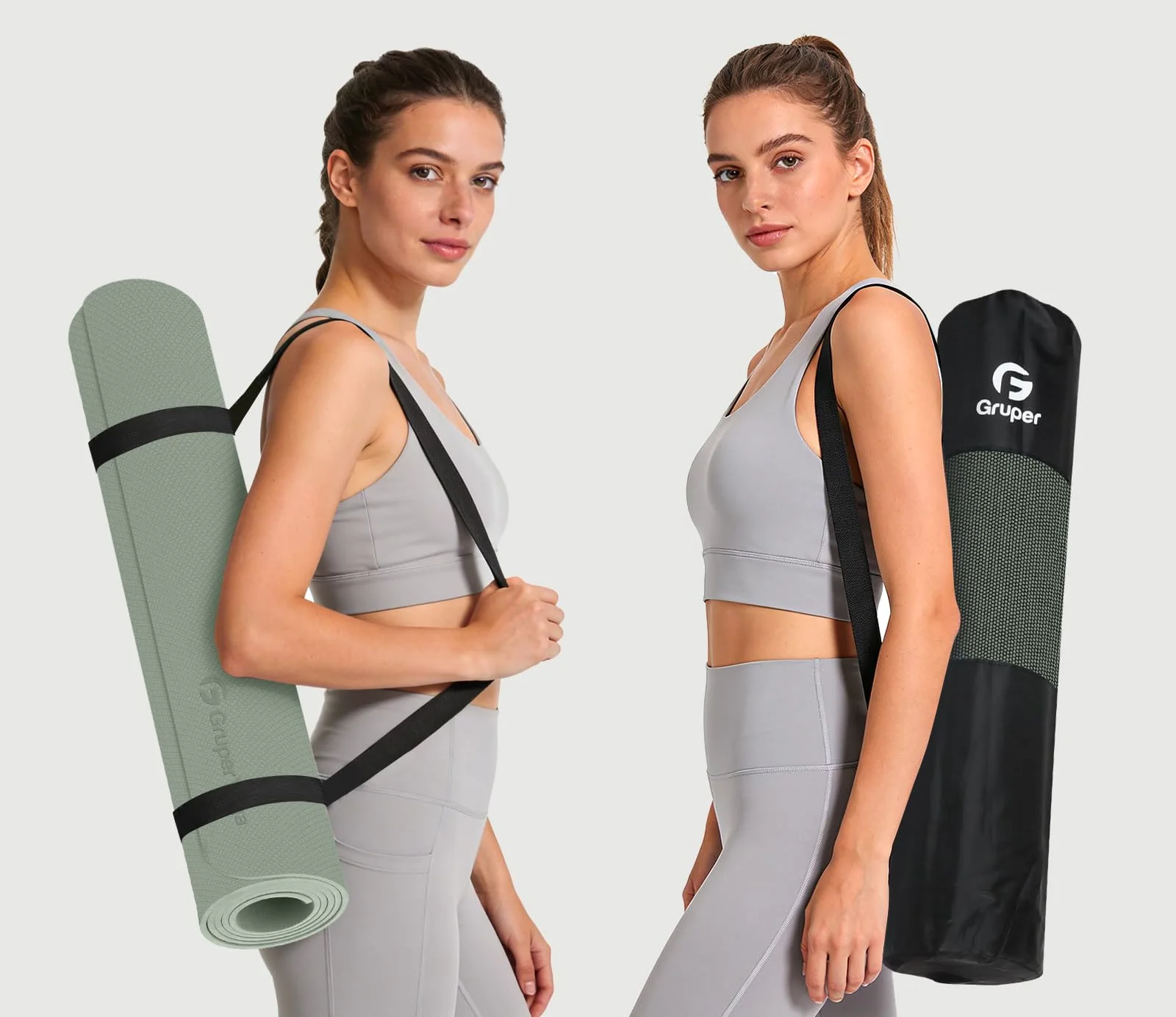
Most advice about mat thickness starts with the practice: flows on thin mats, floor work on thick ones. That is half of the answer. The other half lies under the mat, and it changes the answer more than people expect. A 6 mm mat on a deep carpet feels soft and a little loose. The same mat on a concrete garage floor feels thin under a kneecap within a minute of tabletop.
So before you choose between 6, 8, 10 and 15 mm, look down at the patch of floor you will really use, and think about which part of your session you spend lowest to the ground. The two answers together point to one or two mats, not ten.
On carpet: go firm and thin
Carpet is already a cushion. Put a soft, thick mat on top of it and you stack two soft layers, so your foot sinks twice in a balance pose and the mat can creep across the pile when you step back into a lunge. A firm TPE mat at 6 mm sits flatter and holds its place better.
Texture on the underside matters most here. Our two-tone mat carries the same fine texture on both faces, and our wave-back mat has a wavy underside, both made to hold the surface below. On a long-pile rug no mat grips perfectly, so if you can, practice on the low-pile end of the room. A rug pad under the rug, if you already have one, also stops the whole stack from sliding as one piece.
Size the mat to the rug as well. A mat 72 by 24 inches fits on most bedroom rugs with room to spare. A mat 32 inches across can hang over the edge of a narrow runner, and the step from rug to bare floor under one hand is exactly where a wrist starts to notice.
On wood: almost anything works
Hardwood and laminate are the easy floors. They are flat, they do not shift, and a textured underside holds them well. Here the choice comes back to what you do: 6 mm for standing work, 8 mm if you kneel often, foam if most of the session is on your back or your knees.
Wood is also where a wider mat earns its space. If your living room floor has room for a mat 32 inches across instead of 24, your hands stay on the mat in a wide plank, and you are not pressing one palm half on the mat and half on a smooth board.
One small habit helps on any smooth floor. Unroll the mat a few minutes before you start, and if the ends still curl, roll it the other way for a minute and lay it down again. A corner that lifts under your heel is easier to flatten before the session than to step around during it.
On tile and concrete: add foam for floor work
Tile and concrete give nothing back. Standing poses are fine on a firm TPE mat, but the first time you kneel in tabletop or lie on your side for a leg lift, the floor is right there. This is the floor where our 10 and 15 mm NBR foam mats make sense: the foam is the layer the floor does not have.
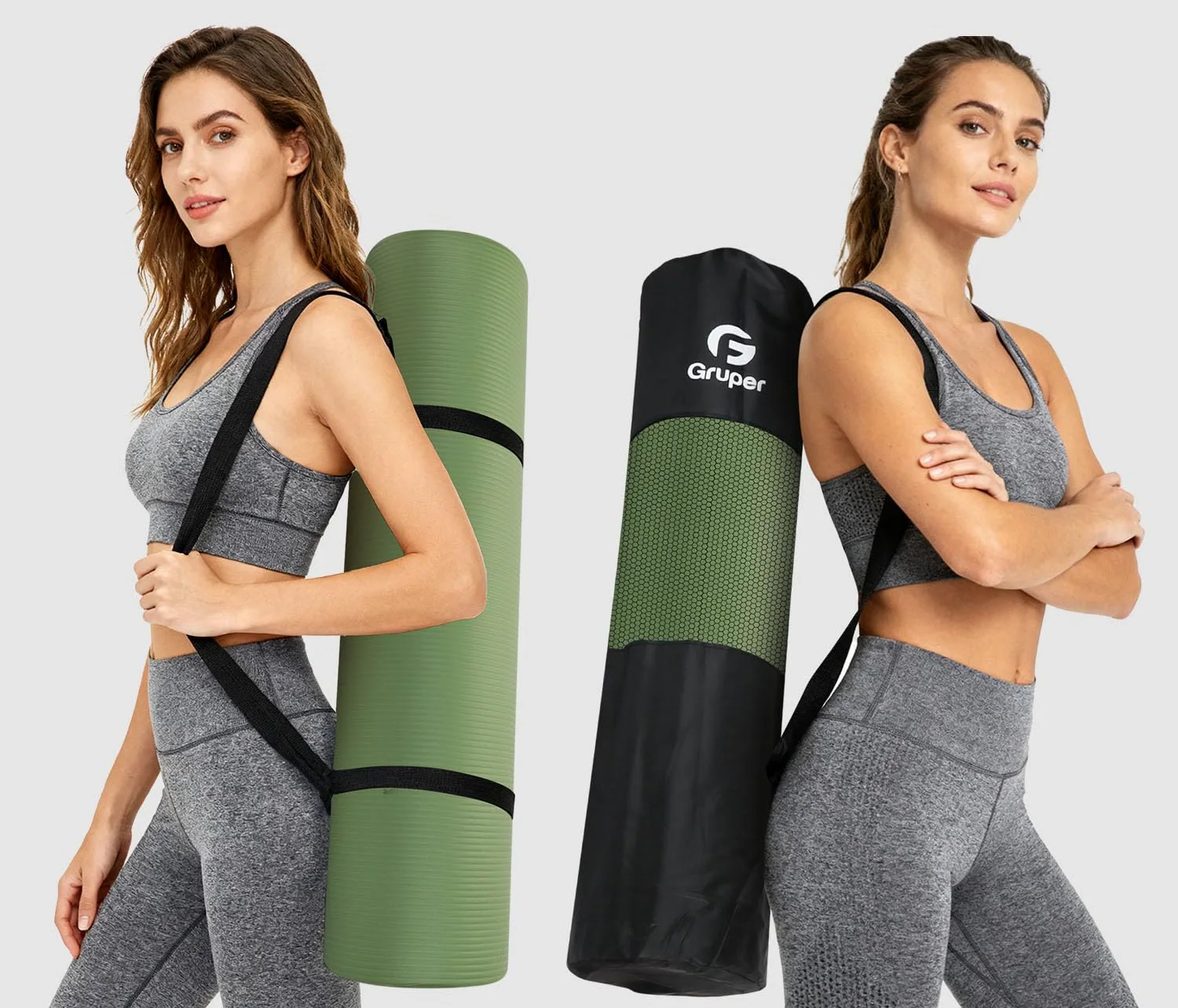
The trade-off is in balance. Soft foam lets your foot settle into it, so tree pose wobbles more on 15 mm than on 6 mm. If your sessions mix both, some people keep a thin mat for standing and lay the thick one beside it for the floor part.
Foam asks for a little patience at the start. The care notes on our NBR mats say to unroll the mat and let it air out for two to three days before the first session, so if the mat is meant for a garage or a basement floor, unpack it a few days early.
| Your floor | Standing and flows | Kneeling and floor work |
|---|---|---|
| Carpet | TPE, 6 mm | TPE, 8 mm |
| Wood or laminate | TPE, 6 or 8 mm | TPE 8 mm or NBR 10 mm |
| Tile or concrete | TPE, 6 or 8 mm | NBR foam, 10 or 15 mm |
How much floor a wide mat needs
Our standard mats are 72 by 24 inches, about 183 by 61 cm. The extra wide mats keep the same length and grow to 32 inches across. On a wood floor that extra 8 inches decides whether both palms stay on the mat in a wide plank or a low lunge. On carpet it matters less, because the carpet is soft anyway. On tile it matters more, because a hand that slips off the edge lands on a hard, cold surface.
Measure with the footprint in mind: 6 feet of length plus room to step forward and back, and either 2 feet or a little under 3 feet of width. The Gruper extra wide yoga mat page has both wide designs side by side, one with alignment marks and one with a mandala print.
Outdoors: think about the bag
A deck, a lawn or a park is a different job. Grass is uneven and often a little damp, so a firm mat bridges the bumps better than a soft one, and the underside will need a wipe afterwards. Every Gruper mat comes with a carrying strap and a storage bag, and the bag is what keeps a damp, grassy mat from rolling up against the inside of your car.
Keep the mat out of long hours of sun. The care notes on our TPE mats say exactly that, so roll it up when the session ends rather than leaving it on the deck until the next one.
Wipe it before it goes back in the bag. A damp cloth with cold water or a mild detergent takes off grass and dust, and the mat should dry flat before you roll it. Our mat care guide covers the rest, including what never to put a mat through.
Think about where the mat lives between sessions too. A 15 mm foam mat rolls up into a much fatter tube than a 6 mm TPE one, and in a small flat that tube stands in a corner every day. Its bag is cut to fit it, but the corner still has to take it.
Before you order
Measure the patch of floor you will use, note what it is made of, and think about the part of the session you spend lowest to the ground. If you are still between two mats, our guide to choosing a yoga mat puts every thickness and width side by side, and the Gruper thick yoga mat page lists every color of the foam mat.
