


Balls
Sitting on an Exercise Ball at Your Desk: How to Set It Up
A ball at a desk is a seat that moves with you. It only works if the size matches both you and the desk, and if you still get up from it.
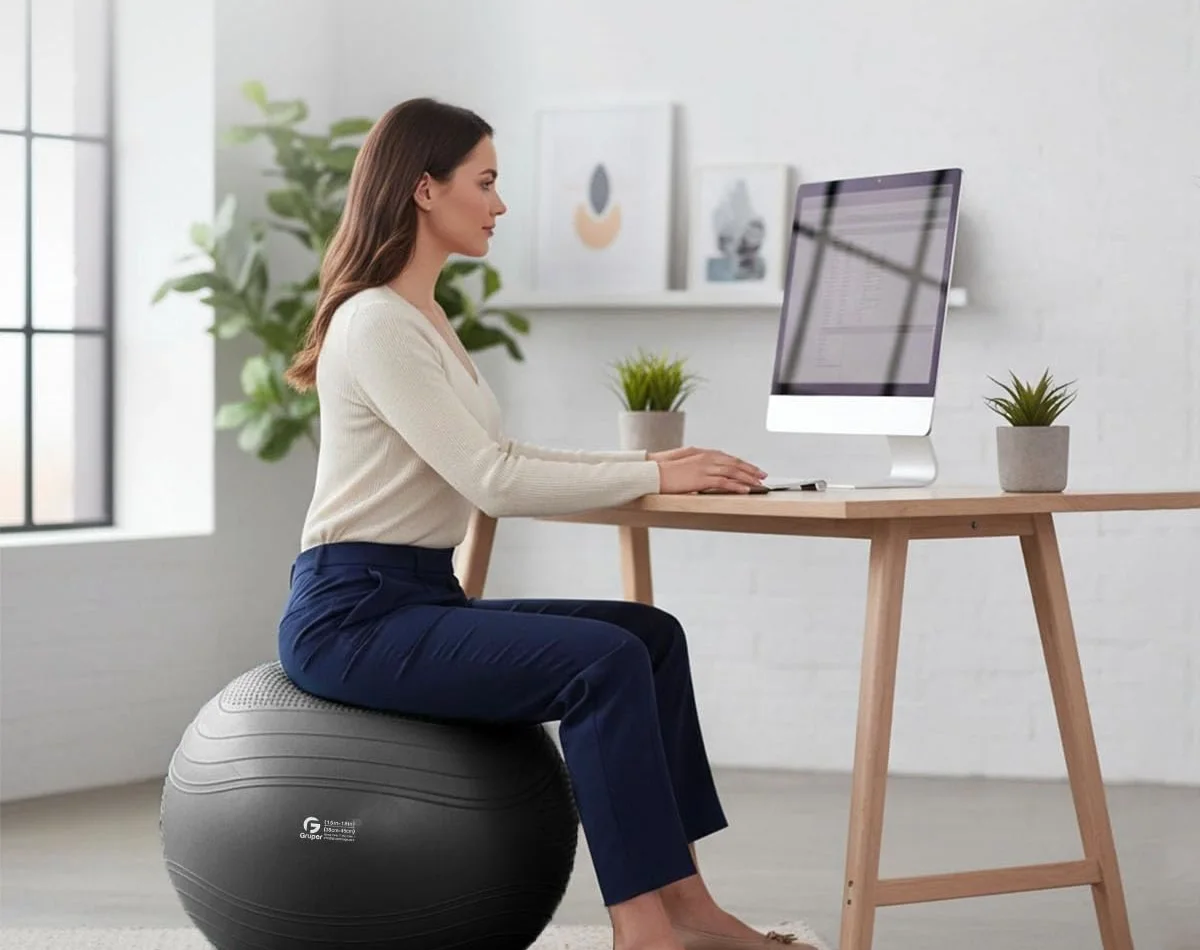
People swap their chair for a ball for different reasons: a restless habit of shifting around, a wish to sit more upright, or just a ball already in the room. Whatever the reason, the setup is the same, and it starts with two heights, yours and the desk's.
Get those two right and the ball feels like a seat. Get one of them wrong and it feels like a balancing act you did not sign up for, which is usually the point where the ball ends up in a corner.
Match the ball to the desk, not only to you
The chart printed with our balls lists a desk height next to every size. That pairing is the useful part for office use: a ball that suits your height but leaves your forearms below the desk edge, or your knees jammed against a drawer, is the wrong ball for that desk.
| Ball | Your height | Desk height |
|---|---|---|
| 45 cm (18 in) | under 4'3" | 20" to 24" |
| 55 cm (22 in) | 4'3" to 5'0" | 25" to 27" |
| 65 cm (26 in) | 5'1" to 5'7" | 28" to 30" |
| 75 cm (30 in) | 5'8" to 6'2" | 31" to 32" |
Measure your desk from the floor to the top of the surface. A desk 29 or 30 inches high pairs with the 65 cm ball on this chart, and a taller one with the 75 cm ball.
If your height and your desk land on different rows, let the desk decide. Your arms have to meet the desk at the same height every working hour, and a ball that leaves them reaching up or down will push your shoulders around more than a small mismatch with your legs.
If two people share one desk, size the ball to the desk and to the shorter of you. The taller person can sit on a ball a size small for a short spell. A ball too large leaves the shorter person's feet off the floor, and on a ball that is the one setup that does not work at all.
Inflate, then sit and check
Pump the ball up to the size on the chart and push the plug in firmly. Our ridged and anti-slip balls come with a foot pump, two air plugs and a plug remover in the box, so the whole setup happens at the desk.
Sit in the middle with your feet flat and hip width apart. Your hips sit level with your knees or a little higher, and your forearms rest at the desk the way they would from a chair. If your hips sink, add air. If your heels lift, let some out or go down a size.
Give it a floor and a parking spot
Floor matters here too. A ball rolls more easily on a smooth hard floor than on carpet, so on tile or laminate keep it close to the desk and stand up from it with one hand on the desk edge rather than pushing off the ball itself.
Clear the patch of floor where the ball sits. A cable, a desk leg or the edge of a rug under the ball makes it roll unevenly when you lean back, and a seat that lurches once is a seat you stop trusting.
When you leave the desk, park the ball in the knee space under it or against a wall. A ball left in the middle of the room drifts, and it tends to drift exactly where someone walks in the dark.
Height of the screen still follows the old rules. A ball does not change where your eyes should land, so set the monitor for the seat height you end up with, not for the chair you replaced.
Getting on and off
Sit down onto the middle of the ball with your feet already flat on the floor, rather than dropping onto it from above. To get up, bring your feet under you, put a hand on the desk edge and stand. Pushing back off the ball sends it rolling behind you, and the next time you sit, it is no longer where you left it.
Take the first days slowly. Sit on the ball for a shorter spell than you would on a chair, notice how your legs and back feel at the end of it, and build from there.
Keep the chair
You do not have to give up the chair to use a ball. Plenty of desks work best with both: the ball for an hour of email, the chair for a long call where you want to lean back. Keep the chair close enough that swapping takes a second, and the ball stays a choice you make during the day rather than a test you set yourself.
What a ball does not do
A ball is not a treatment. It does not fix your posture or ease back pain on its own, and if you already have a back problem, ask a doctor or a physical therapist before you sit on one for a whole workday. What a ball does is make it easy to shift, rock and change position, which some people simply find more comfortable than a fixed chair.
It also does not replace getting up. The CDC puts the adult target at 150 minutes of moderate activity a week plus muscle-strengthening work on two or more days, and gives 30 minutes on five days as one way to get there. Its short version is move more, sit less. A ball is still sitting. Stand, walk and stretch during the day as you would from any chair.
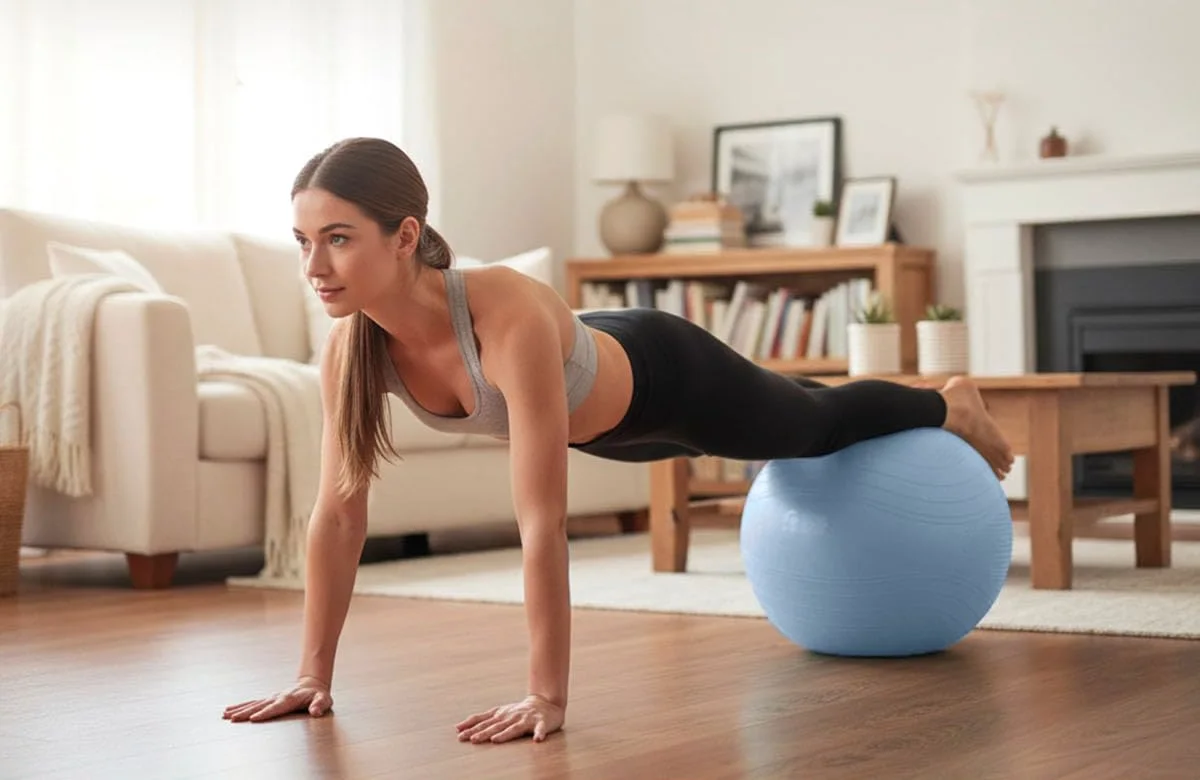
The ball can help with the getting up part too, once it is off duty as a seat. For floor work beside the desk, any of our yoga mats gives your hands and knees something softer than the floor.
Which of our balls to put under a desk
All three of our balls come in the four sizes in the chart. The anti-slip stability ball has a glazed, grippy finish, which helps on a smooth office floor. The ridged ball has the thickest wall, 2.8 mm, and a patch of massage beads you will notice when you sit on it. The classic ball comes in five colors if it has to match a room.
Color is not only taste under a desk. A dark ball hides scuffs from shoes and a dusty floor better than a pale one, and a pale ball is easier to spot when it has rolled under the desk by evening.
Whichever you pick, our ball size guide has the sitting check in more detail, and the yoga and exercise balls shelf puts all three side by side.
